

How Much Water is Necessary for Perfect Mountain Reflections
- Joy Curtis
- Dec 13, 2025
- 2 min read

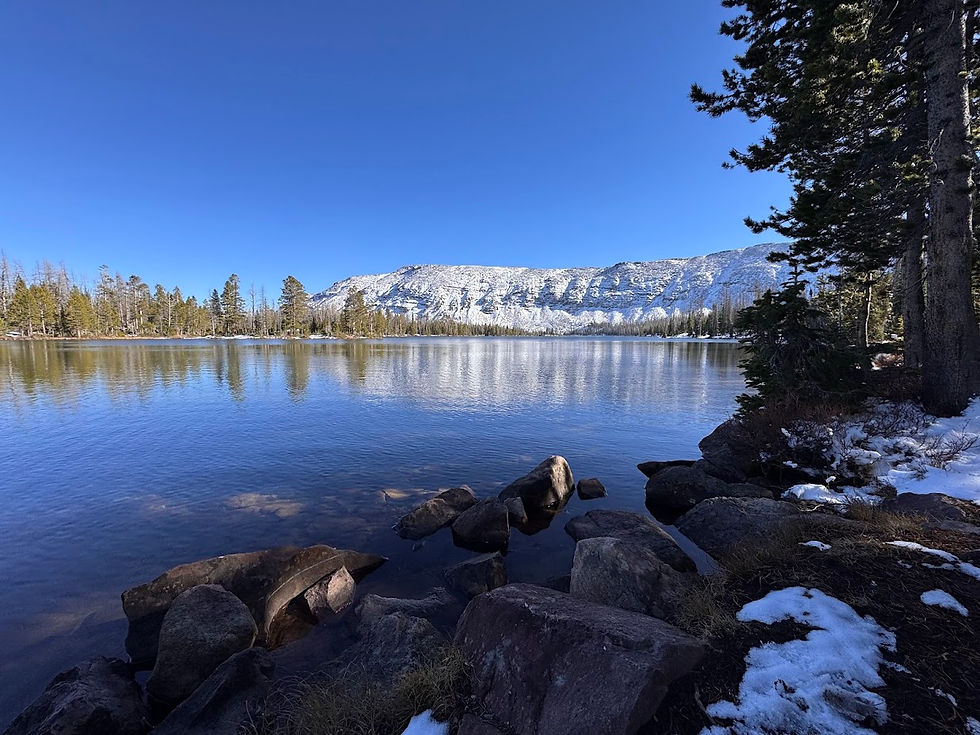
This image is from a hike in the Unita Mountains and the reflection of a peak in a glacier lake. Alfred Castner King’s poem Reflections captures this phenomenon with vivid detail and thoughtful insight.
The Full Poem: Reflections by Alfred Castner King
On the margin of a lakelet,
In a rugged mountain clime,
Where precipice and pinnacle
Of countenance sublime,
Cast their weird, austere reflections
In the water's glistening sheen;
I strolled in contemplative mood,
Both pensive and serene.
As in a crystal mirror,
In that lakelet's placid face,
I saw the mountains upside down,
With all their pristine grace;
I saw each cliff and point of rocks,
I saw the stately pine,
Inverted in fantastic form
Below the water line.
I paused in admiration;
And with calm complacency
I marveled at this photograph
From nature's gallery;
And as my eyes surveyed the scene
With solemn grandeur fraught,
This simile flashed through my mind
As instantly as thought:
As the stern, majestic mountains,
Without error or mistake,
Were reflected in the bosom
Of that cool, pellucid lake,
So our every thought and action,
Be it deed of hate or love,
May be photographed in record
In that gallery above.
Understanding the Poem’s Reflection of a Mountain
King’s poem paints a vivid picture of a mountain reflected in a small lake, or lakelet. The poet walks along the edge of this body of water, observing how the mountain’s cliffs, pinnacles, and pines are mirrored perfectly in the calm surface. The water acts like a crystal mirror, capturing every detail without distortion.
The poem’s reflection is more than just a physical image. It becomes a metaphor for how every thought and action is recorded in a higher “gallery above.” This suggests that just as the mountain’s reflection is clear and exact, so too are our deeds and intentions captured in some form of moral or spiritual record.
How Much Water is Needed to Reflect a Mountain?
Literally speaking, the amount of water needed to reflect a mountain depends on several factors:
Surface Area: The water body must be wide enough to capture the mountain’s full image. A narrow stream or puddle won’t show the entire mountain.
Calmness of Water: The water must be still and smooth. Ripples or waves distort the reflection.
Depth: Depth is less important than surface calmness, but deeper water tends to be more stable and less prone to disturbance.
Angle of View: The observer’s position relative to the mountain and water affects how much of the reflection is visible.
In King’s poem, the “lakelet” is described as having a “placid face” and “cool, pellucid” water, suggesting a small but perfectly still and clear pool. This implies that even a modest amount of water can reflect a mountain if the conditions are right.


Comments